The end of the semester, for many students, means weeks of studying for assignments, presentations and last-minute deadlines. For others, it means spending three hours in a dark auditorium watching 29 student short films back-to-back.
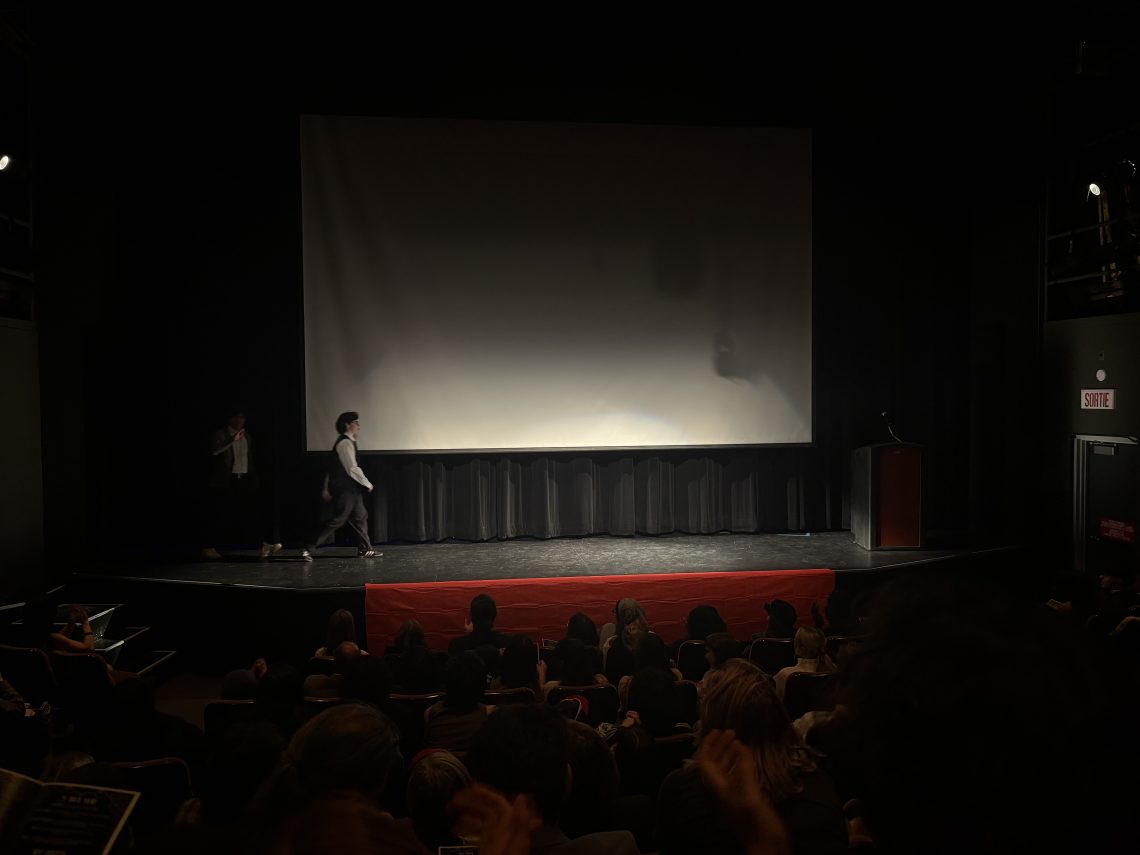
On December 5th, the Dawson Film Festival, most commonly known as the DFF, transformed Dawson College into something that felt briefly unrecognizable. The usual, repetitive weekday rhythm of the campus slowed down and shifted entirely around the occasion. Students from every program arrived dressed in tailored suits, dresses, and carefully chosen outfits rarely seen in Dawson’s hallways. Meanwhile, the entrance of the Dawson New Dome Theatre glowed like a Christmas tree in a Hallmark movie, amplifying the unique atmosphere of the event. The room itself is large and imposing, a massive screen standing out against grey soundproof walls. The stage below it is relatively small, but fancy enough to leave a lasting impression on the audience.
By the time the last guests arrived, small clusters of people were already debating which films they were most excited to see.
Similarly, behind the scenes, the atmosphere was far from calm. While the audience lined up outside the Dome in the freezing December cold, the thirteen students responsible for the festival’s production moved quickly through the theatre, carrying papers and laptops, checking schedules, and practicing lines. Their restlessness was the result of an entire semester of preparation and decision-making, all ultimately building up toward the event itself.
The Dawson Film Festival is organized each year by students in the IA (Integrating Activity) class, a course that allows students to be in charge of a large-scale creative project related to the content of their Profile. Most years, the IA class consists of around thirty students, allowing responsibilities to be equally divided. This year was different. With only thirteen students enrolled, the fate of the entire festival depended on a much smaller team.
One of those students was Mika Sauvageau, who has been involved in the festival since the beginning of the semester. When speaking about this year’s experience building the festival, Sauvageau emphasized how drastically the structure changed with the reduced class size.
“This one was interesting because it was an off semester, so there were less people than usual,” she explained. “Normally, with around thirty people, you have a very specific role. But this year, we were closer to ten, so the number of tasks you have is much more varied.”
Due to this variety, Sauvageau’s role was ever-changing. Over the course of the semester, she jumped between creative, managing, and technical responsibilities. One day, she was helping write the festival script, the next, she was contacting sponsors, keeping in touch with the judges, and working on the organization of the evening itself. On the night of the festival, she took on a role invisible to the 190-person audience, yet undeniably essential.
“I’ll be in the booth,” she said. “Projecting the films, making sure the sound level is good.”
From the projection booth, the festival took a whole new, different look. While the audience sat in rows of comfortable, brown velvet chairs, Sauvageau controlled the technical elements that determined whether each film was heard, seen, and experienced by the viewers as optimally as possible.
This year’s festival also introduced a shift that significantly changed how the event had been built in previous semesters. Instead of keeping all responsibilities within the IA classroom, the organizing committee reached outward, involving students who were not initially part of the class.
“Usually, the people involved in the festival are only the people in the class,” Sauvageau stated. “But this year, we wanted more outreach, especially first-year students who wouldn’t necessarily have had the opportunity to be part of it.”
The idea came from lengthy reflection within the committee. Sauvageau, for instance, remembered her own first semester at Dawson, when the festival felt distant and almost out of reach, something merely talked about by the older students in the Cinema and Communications program, but not easily accessible. To her, it felt more like an urban legend than a true, realizable project.
“We were thinking about ourselves in our first semester; how it would have been interesting to be involved in the festival before even being in that class, and how we would have participated in it.”
Their outreach incontestably paid off. The festival sold out the day before the event, filling all 190 seats in the Dome, something that does not happen every year. The chosen sponsors contributed prizes, including cinema tickets for the winners of each category, and a private tour of MTL Grandé Studios, a professional studio where major projects, including some associated with Denis Villeneuve, have been shot.
This semester’s festival also introduced a brand-new twist to the customary structure of the event. Having chosen a Hollywood and Oscars-inspired theme, the organizing committee rethought how the films were going to be presented and judged. Instead of, as seen in previous years, screening all films first and announcing the winners at the end, categories were introduced throughout the evening, with films presented in between.
“Usually, we screen all the movies and, at the end of the night, the judges come on stage and tell us the winners of each category. But, what we found is that, a lot of times, the people don’t remember the films, because they watched so many.” Sauvageau explained.
Typically, the festival receives between 80 and 120 submissions per semester, depending on the time of the year. All the films received are then narrowed down to around 25 selections, all of which are then screened for the audience on the night of the festival. From there, the final award– the “Coup de Coeur”, an acknowledgement for the film that stood out the most beyond the established categories– is decided in real time, adding tension and excitement for both the students involved and for the audience rooting for their favourite film.
That tension was palpable throughout the whole week leading up to the event. The entire Dawson campus became a rehearsal space for the frenzied students of the Cinema and Communications program.
Fabiana Parra Calao, a student hosting the Best Animation Film category, and her co-host, Martin Castillo, prepared for the event multiple days ahead.
Under the Dawson Dome’s carousel-like ceiling lights, near a red carpet rolled out across the floor in anticipation of the lineup of students on the day of the festival, Calao and Castillo practiced their lines with a technician in charge of organizing the event’s timing and cues.
They stood a few feet apart, scripts open on their phones, occasionally glancing up at the empty space in front of them, imagining the audience that would soon fill the seats.
“We can improvise on stage, right? Because we thought of a few jokes.” Calao asked, half-joking, half-serious, as she looked at the technician.
“Sure,” she replied, smiling. “Just make sure to say what’s on the paper we gave you.”
Calao turned back to Castillo, rambling on about how she wanted their hosting to feel personal and natural, rather than scripted and stiff. As the presenters for the Best Animation Film category, they had come up with lines referencing Studio Ghibli films and comparing animation films to comfort food: familiar and heartwarming. They ran through the segment again and again, adjusting their tone and pronunciation, arguing over whether or not they could fit in more jokes.
The day before the festival, rehearsals moved into the auditorium itself. Standing on the small stage beneath the massive screen, 7 pairs of hosts practiced their introductions to each separate category.
At one point, a technician laughed from the booth. “Oh, that’s perfect— it’s funnier that way,” she said, reacting to a joke involving a projected image on the big screen, inspired by a viral Oscars meme of Jonah Hill.
When the presenters practiced pausing before revealing a winner, she called out again: “Can we get more suspense!”
These casual and unseen moments are where the festival truly took its shape. They reflect the collaborative effort behind an event that, for the viewers, appears seamless and well-thought-out.
For Sauvageau, that concept of collaboration is at the heart of the festival.
“I think it’s almost less about expressing yourself than it is about people coming together in a space,” she said. “Not in a classroom, but in a place where they can lift each other up and celebrate.”
She paused before adding, “A big part of being in the arts — especially in cinema— is about the people you meet and the connections you make. Fifty percent of it is networking, honestly. The festival is an opportunity for that, and that’s what makes events like these so special.”
As the night unfolded, young, aspiring filmmakers watched their work be displayed on a screen far larger than anything they had ever had access to during the semester, or even before. Students cheered loudly for their friends, and strangers applauded films they’d fallen in love with in the span of three, quick hours.
“It’s very altruistic,” Sauvageau said. “Showing other people’s work, and getting recognized for your art. The intention behind the festival is really to uplift artists and show what we’ve been working on in the program, all semester.”
Once the final awards were announced, the Dome slowly emptied. The lights dimmed, and the auditorium returned to its mid-semester stillness.
The Dawson Film Festival may last only one night, but for the students who build it, its impact extends far beyond the big screen. The DFF is a stark reminder that the most important part of creating art is getting together and celebrating one another’s work under the same lights.

